Elkton
1915
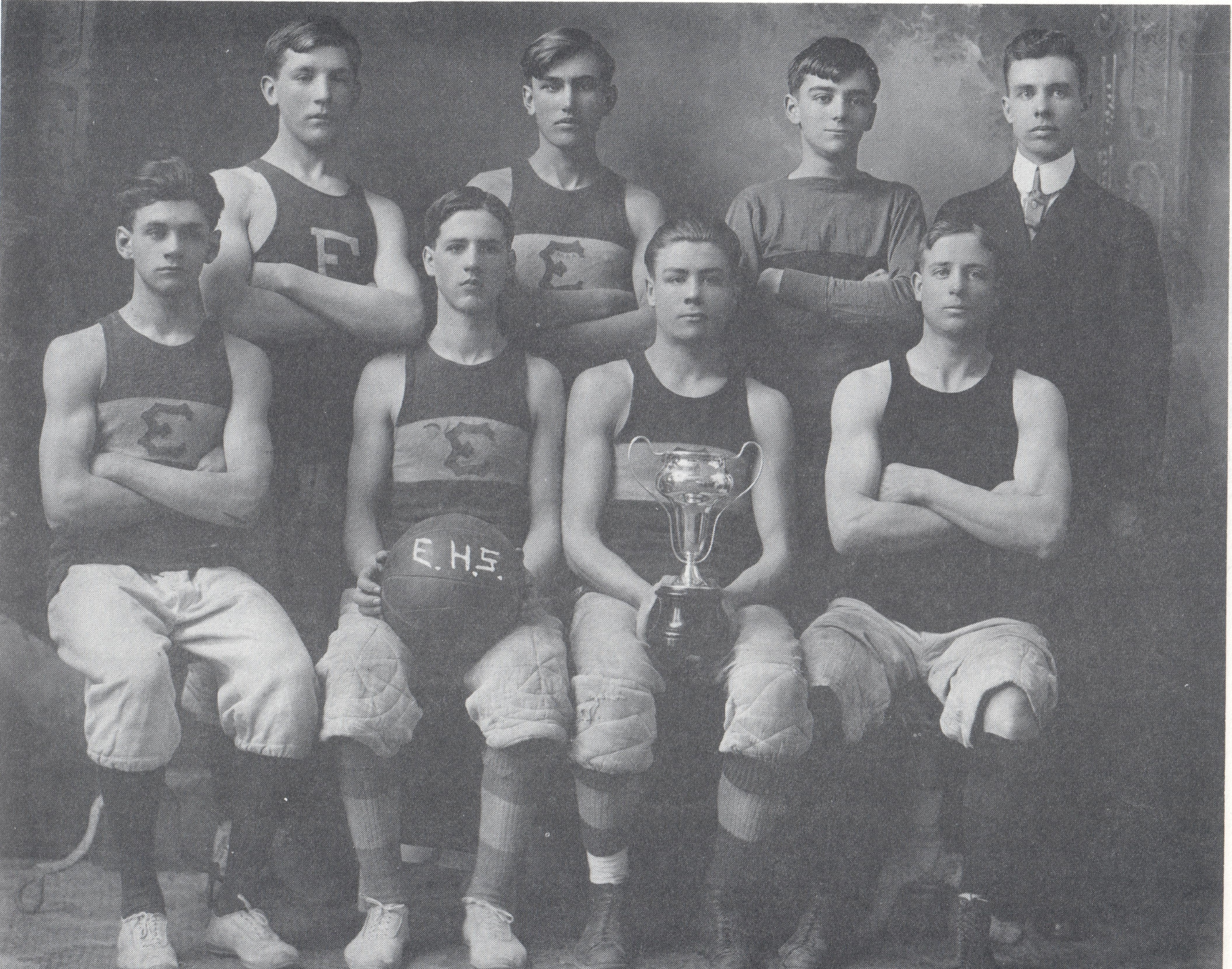
Seated (l to r), Walter Dillman, Charles Kearney, Eddie Timm, Ray Alberts. Standing, Robert Main, Harris Bairey, Howard Stillman, Supt. and coach L. A. Hayworth.
Elkton won their first state basketball championship in 1915, beating Salem in the title game, 29-28.
Elkton won their first game of the tournament on Friday, beating Waubay, 61-22, and then played three games on Saturday. Miller fell in a morning game, 44-19. Their afternoon game against Centerville was another blowout with Elkton winning easily, 54-19. At one point, Elkton ran off nearly three minutes from the clock with an awe-inspiring passing display.
The championship game against Salem that night was a thriller. Salem took an early 5-1 lead, but Elkton fought back to tie the game. The teams played back and forth the rest of the half and Salem led, 14-13 at the break. Elkton built a 25-18 lead midway through the second half only to have Salem closed the gap down the stretch. Elkton led 29-28 late but a foul put Salem on the line with a chance to tie the game. They missed and time expired.
In the early years, high school teams were often managed like sports clubs. A team charged admission to their home games and used the gate to buy equipment, pay expenses, and cover team travel. This led to teams playing games even after the state tournament. In the early years, it was common for the high school teams to play games against the college teams.
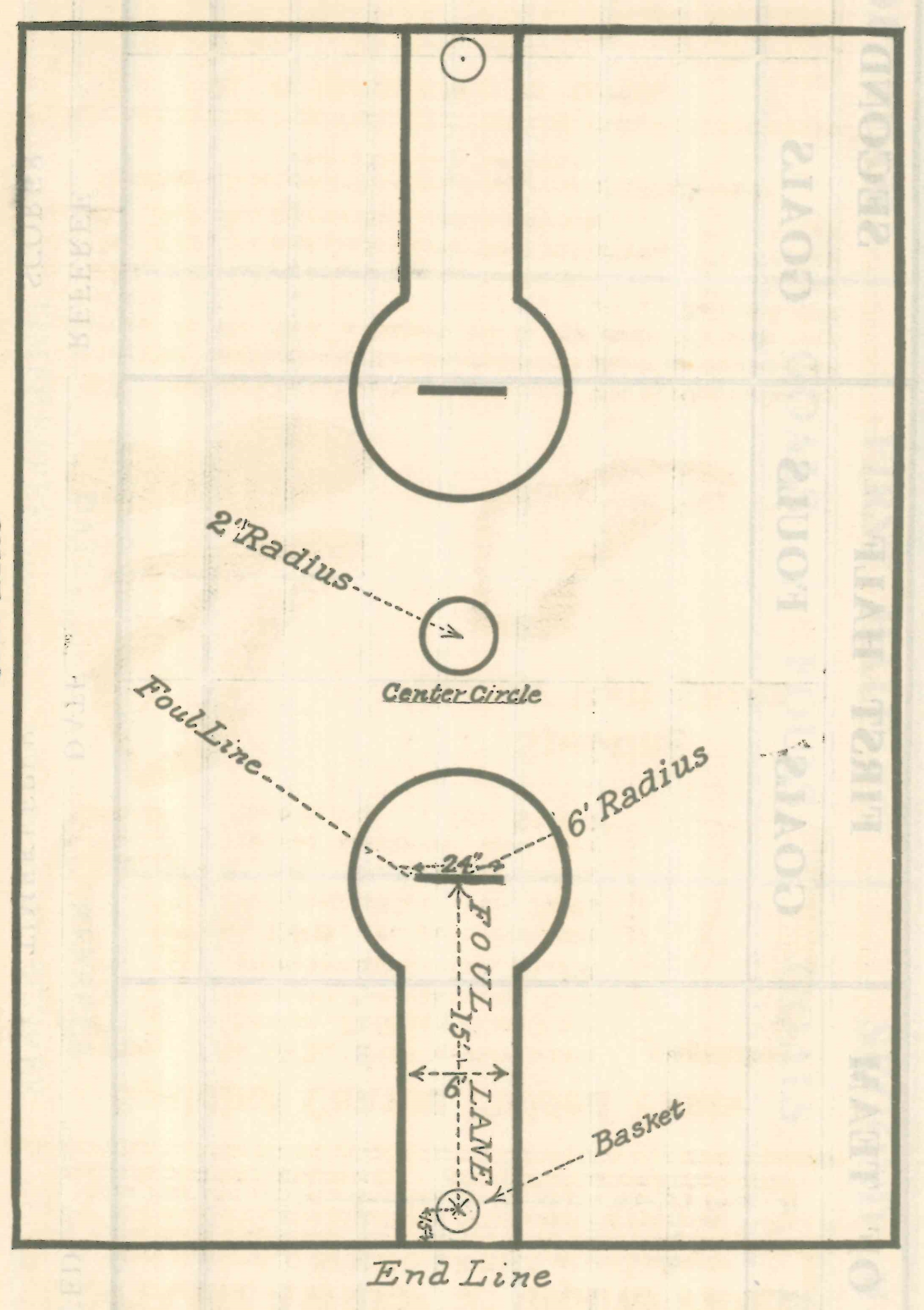
Game rules were far simpler. There was a jump ball after every basket. On a foul, the team could take a free or the ball. Games were two, twenty-minute halves. If there was a substitution, the player had to sit out the rest of the half. No three second violation existed. The lane was six feet wide. With the free throw line and circle, they formed a shape similar to a keyhole, hence the term, “key”. There wasn’t a center line or an over and back violation. A high-scoring game might be 30 points. A coach couldn’t instruct players during a game but could only make substitutions, call timeout, and decide whether to take a free throw or the ball after a foul.
Team travel was usually by train. The season started in January with the state tournament in March.
Elkton played their home games in an opera house known as The Grand. The building was unheated and had twelve-foot ceilings. Elkton was the only small town to win the state championship in the single-class system. All the other state champions were county seats.
Huron College sponsored the tournament in the early years before the SD High School Athletic Association took control of the tournament. Huron College offered a large, silver loving cup to the first team to win three state championships.
In the early years, high school teams were often managed like sports clubs. A team charged admission to their home games and used the gate to buy equipment, pay expenses, and cover team travel. This led to teams playing games even after the state tournament.
Game rules were far simpler. There was a jump ball after every basket. On a foul, the team could take a free or the ball. Games were two, twenty-minute halves. If there was a substitution, the player had to sit out the rest of the half. No three second violation existed. The lane was six feet wide. With the free throw line and circle, they formed a shape similar to a keyhole, hence the term, “key”. There wasn’t a center line or an over and back violation. A high-scoring game might be 30 points. A coach couldn’t instruct players during a game but could only make substitutions, call timeout, and decide whether to take a free throw or the ball after a foul.Game rules were far simpler. There was a jump ball after every basket. On a foul, the team could take a free or the ball. Games were two, twenty-minute halves. If there was a substitution, the player had to sit out the rest of the half. No three second violation existed. The lane was six feet wide. With the free throw line and circle, they formed a shape similar to a keyhole, hence the term, “key”. There wasn’t a center line or an over and back violation. A high-scoring game might be 30 points. A coach couldn’t instruct players during a game but could only make substitutions, call timeout, and decide whether to take a free throw or the ball after a foul.
Courtesy SDHSAA
Elkton played their home games in an opera house known as The Grand. The building was unheated and had twelve-foot ceilings. It was the first championship that went to a team that wasn’t a county seat.
1918
Elkton failed to advance in 1916 and 1917. Sioux Falls (now Washington High School) captured the title from a field of 27 teams in 1916 and Huron won the championship from a pool of 28 teams in 1917.
Elkton was state runner-up in 1918, dropping the championship game to Lead, 20-11. The 1918 tournament was played in the midst of America’s involvement in World War I and the spreading Spanish Flu epidemic.
The state tournament was held in Huron and was hosted by Huron College. For the first time district tournaments were held around the state to determine qualifiers for the state tournament. Teams were split into eight districts which were allowed to determine the state qualifier by a tournament or through head-to-head competition during the season. Lead qualified based on their regular season record against other district teams while the other qualifiers won a district tournament two weeks before the state meet.
Elkton won the District 2 tournament beating Brookings 13-12, doubling up Gettysburg, 44-22, and then topping Doland, 33-29. They then ousted defending state champion Huron, 24-22, for the title. This win was the start of a fierce rivalry between the two that played out over the next two years.
Elkton drew a bye in the first round of the tournament (District 8 didn’t send a team) while Lead squeaked by Mitchell, 27-25. Mitchell jumped out to a 15-7 lead and held a 16-11 halftime edge. Lead fought back to tie the game at 21-21. It was back and forth from there with Lead hitting a shot in the last minute to secure the win.
Semifinal
Elkton beat Aberdeen 25-21 in their semifinal game. Robert Petschow hit a late shot for Elkton that preserved the win. Lead slipped past tournament favorite, Dell Rapids, 19-18, in a come-from-behind win.
Championship game
Elkton jumped out to a 4-0 lead early in the game. Petschow, a junior, scored first for Elkton and rising sophomore standout, Leonard “Jimmie” Lovley scored the other nine points for Elkton.
Lead stopped in Pierre for a game on their return trip to the Hills. It was common practice for teams to play games even after losing in the playoffs. Teams relied on gate revenue to defray expenses so an opportunity to play was always tempting. Pierre bested the newly-crowned champions, 17-16.
1919
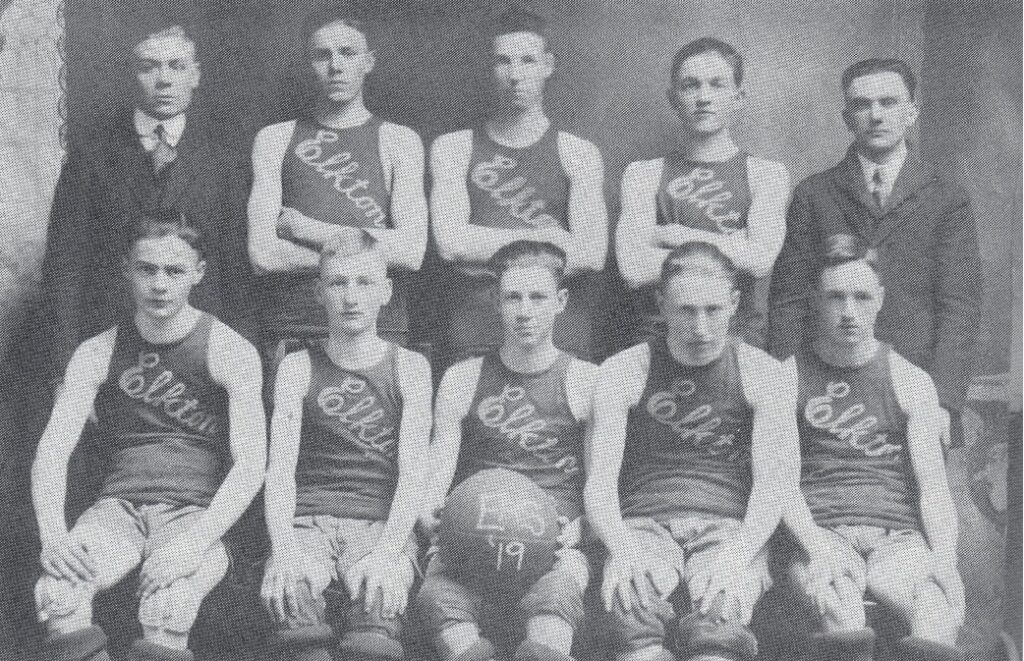
Elkton captured its second state basketball championship with a dominating run through the tournament. Their 42-6 win over Mitchell in the championship game remains one of the most lopsided scores in tournament history. Elkton lost just a pair of games in the regular season that included a 26-13 doubling of the “Aggies” of South Dakota State College.
Huron beat Elkton in an early season matchup, payback for Elkton’s win over Huron in the 1918 district tournament. Huron, winner of ten straight games fell to Redfield, 25-21, in the district tournament denying them a trip to the state tournament in their home city.
Elkton had little trouble in their district tournament. They dominated Clear Lake by the “awful score” of, 50-14. It was their third, thirty-point win over them in less than a month. Brookings downed Iroquois, 26-17, setting up the championship matchup. The title game was even more one-sided with a decisive 45-5 score as “Elkton walked over, through and across Brookings”.
State Tournament Schedule
Thursday, March 20th
3:30 Elkton 28 Dell Rapids 11
4:30 Flandreau 27 Redfield 21
7:30 Yankton 29 Lemmon 7
8:30 Mitchell 18 Lead 12
Friday, March 21st
10:30 Elkton 23 Flandreau 13
11:30 Mitchell 20 Yankton 13
8:00 Elkton 42 Mitchell 6
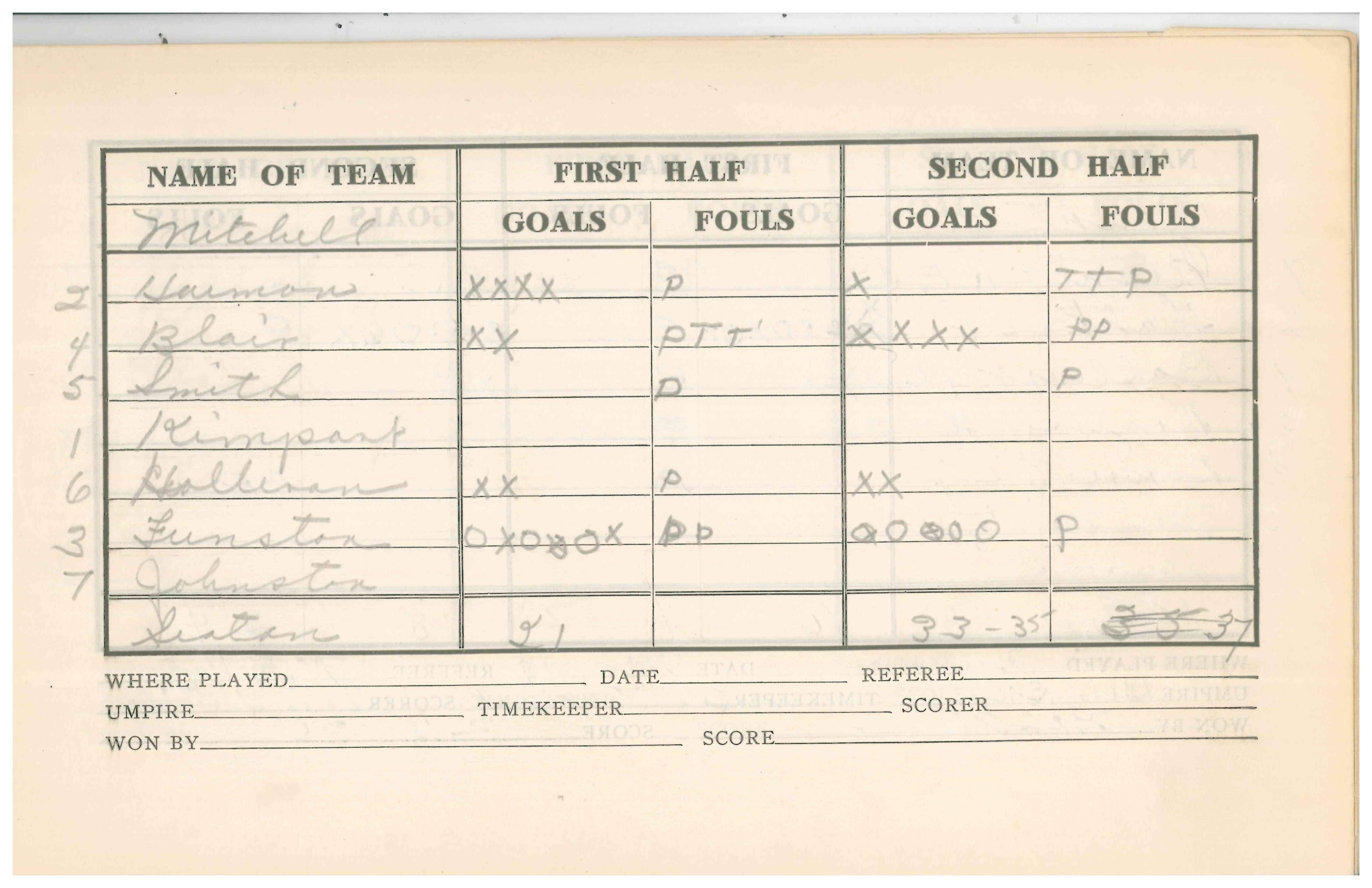
Mitchell’s Leo Harmon scored all six points for Mitchell, a field goal and two free throws in the first half and a pair of free throws in the second half. Elkton led 18-4 at halftime and finished with 18 field goals and four free throws. Lovley and Trautman were complimented for their scoring skill and Hartwig was recognized for his defense. Lovley, Smith, and Petschow were all-state selections and Hartwig was a second team nod.
Huron made a futile attempt to arrange a game against Elkton, but the newly-crowned champions declined. The two teams would meet twice the following year.
Elkton 1919 Schedule
Date Opponent Score
9-27-18 Volga 37-18*
1- 3-19 Huron 12-37
1-17-19 Flandreau 36-41
1-31-19 Lake Benton 36-21
2- 7-19 Walnut Grove 75-12
2-14-19 Jasper 51-21
2-21-19 Clear Lake 57-16
2-23-19 Aggies 26-13**
2-28-19 Clear Lake 57-18
District 2
3- 7-19 Clear Lake 50-14
3- 7-19 Brookings 45-5
State Tournament
3-20-19 Dell Rapids 28-11
3-21-19 Flandreau 23-13
3-21-19 Mitchell 42-6
*The date listed in the newspaper article seems inaccurate. A more accurate date is probably 12-27-18.
**The Aggies were the team representing the agriculture students at South Dakota State College.
1920
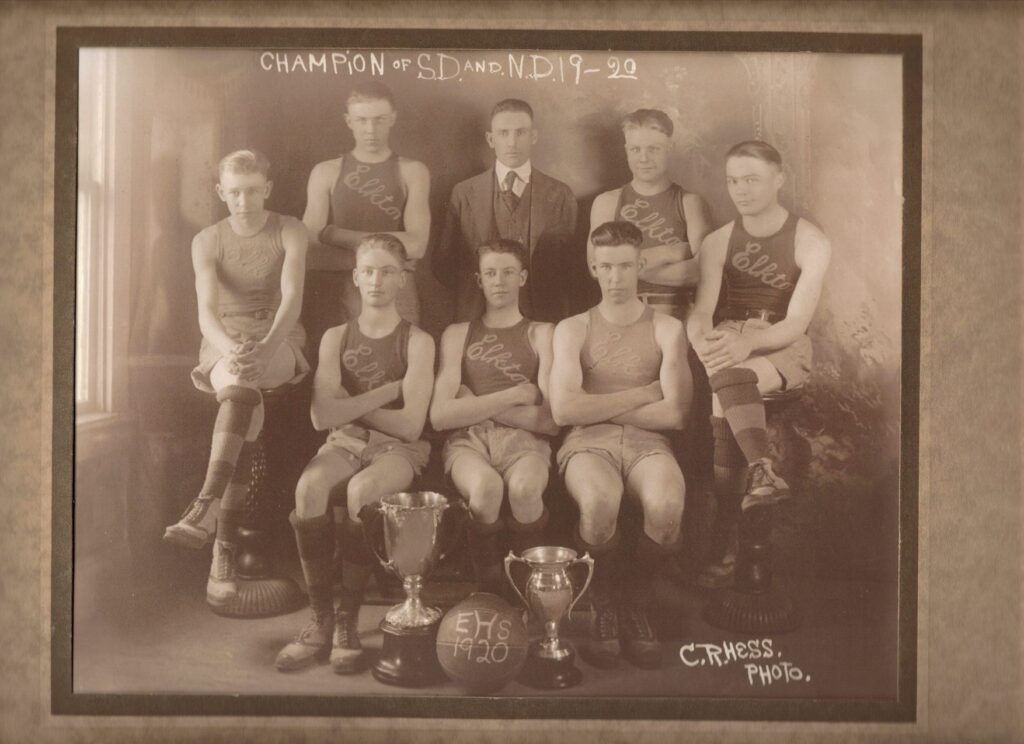
Seated: Harry Timm, William Kelly
Standing: Adolph Hartwig, Coach Floyd G. “Tommy” Thompson, Harry Fjerstad
Elkton was South Dakota’s first basketball dynasty. They made six straight state tournament appearances, were runner-up in 1918 and won championships in 1915, 1919, and 1920.
Their third state basketball championship came amid a flurry of accusations, threats, intimidation, and attempted bribery.
Elkton beat Huron, 25-24, in Elkton, in the season opener in January. They played their games in an unheated opera house with twelve-foot ceilings named The Grand. Huron led, 22-7, at one point before Elkton mounted a furious comeback. Huron had to have their own referee for the game and complained about the court. This only intensified a growing rivalry between the towns.
The team lost an early season game at Redfield, 19-11. In a late January train trip the team won five games in as many nights.
| Monday | Huron | 30-23 |
| Tuesday | Mitchell | 22-13 |
| Wednesday | Vermillion | 30-12 |
| Thursday | Yankton | 20-8 |
| Friday | Sioux Falls | 43-17 |
Elkton was 19-1 and Sioux Falls was undefeated when they met. The Orange and Black were coached by the legendary Howard Wood. Elkton had just seven players but was described as a “basketball machine” by The Daily Argus Leader.
Elkton’s 6’2″ Leonard “Jimmie” Lovley, scored 27 in the game. 27 points was more than any of Elkton’s opponents scored that week and more than most teams averaged. The Daily Argus Leader commented, “Captain Lovely, (sic) speedy right forward for the Elkton team, was easily the star of the game. His basket shooting being the best ever seen on the local floor.”
Lovley went on to a sterling career at Creighton University. He was twice team captain and named an All-American as a junior and a senior. He went on to become a dentist in Verdigre, NE. When The Sioux Falls Argus Leader named their all-time team, he was named the captain. He is in the SD Sports Hall of Fame.
Over 70 teams took part in the 1920 playoffs with teams split into eight districts. Elkton earned a state tournament trip to Huron by beating Lake Preston, 62-4; Doland, 78-2; Clark, 42-17; and Watertown, 29-12.
Huron College sponsored the tournament in the early years before the SD High School Athletic Association took control of the tournament. They had offered a large, silver loving cup to the first team to win three state championships. Elkton already had two championships, winning titles in 1915 and 1919. Six other teams had each won a title. The prospect of an Elkton championship in 1920 drew much speculation around the state and made that trophy the center of attention and controversy.
Accusations were leveled by Huron claiming Elkton had played a game against the college in Brookings. Another allegation claimed one of the Elkton players had been paid for playing in a game with the men’s team. Both claims were dismissed by the Board of Control of the activities association.
Several teams lodged complaints against Huron as well stating they had used ineligible players. The Board of Control, after a sixteen-hour day, declared most of the Huron team ineligible because they weren’t passing their classes and that the Huron administration had covered up the matter. As a result, Huron was ousted from the tournament and banned from the athletic association for a year. Redfield, the district runner-up, was admitted in their place.
The rulings did not sit well with many in Huron, and threats against the Board of Control and the Elkton team were made. Cooler heads prevailed and the tournament went on as scheduled.
Elkton had had no trouble with Redfield in the first round, winning 38-16. Lovley had 22 points outscoring the entire Redfield team.
A “tournament” blizzard on the first day knocked out the telegraph and telephone lines and stopped all train travel. Communications weren’t restored until noon the next day.
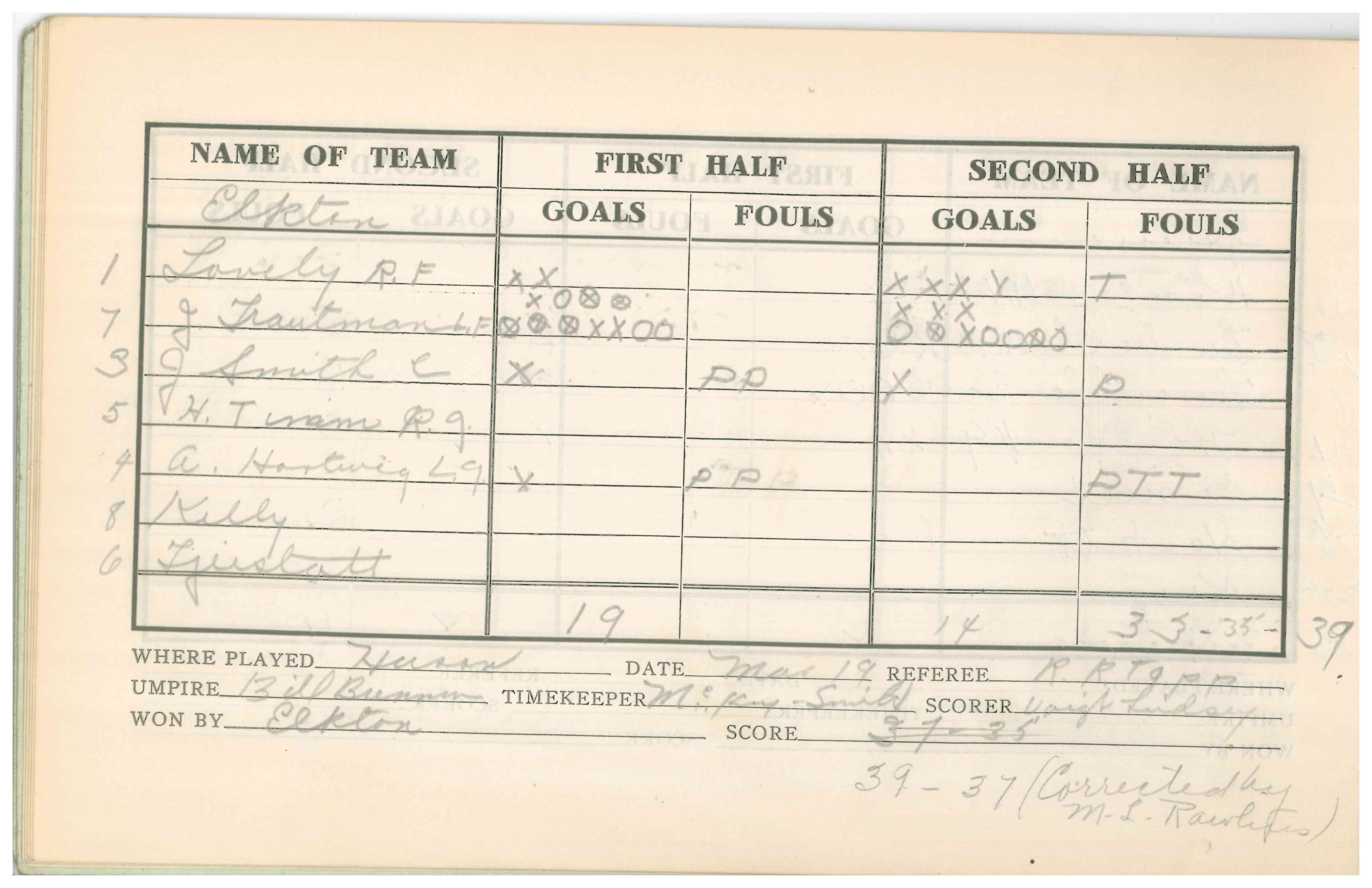
Elkton had beaten Mitchell in the 1919 championship game by the lopsided score of 42-6. Their 1920 semi-final is considered a classic. Most of the crowd sided with Mitchell and drowned out the small Elkton contingent. Mitchell led 21-19 at the half, regulation ended in a 33-33 tie, and it was 35-35 after a five-minute overtime. Elkton’s 6’3″ center, Joseph “Cy” Smith, hit a long shot at the end of the second overtime, clinching a 39-37 win. Johnny Trautman scored twenty-one for Elkton.
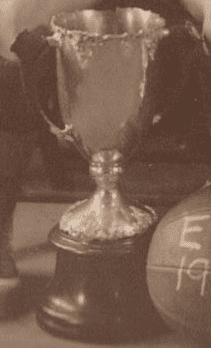
That night Elkton beat Madison in the final, 31-20. The silver loving cup for the first team to win three state championships was awarded to Elkton and is now on permanent display in a special case at the school.
Lovley and Trautman were first team all-state selections at forward. Adolph Hartwig was a second team honoree at guard. Freshman, Harry Timm, was the other starter for Elkton. Johnny Trautman went on to a successful basketball career at Creighton and later received a medical degree.
The team went on to win two games at a regional tournament in Madison, WI. One win was over Jamestown, the champion of North Dakota.