South Dakota High School Basketball
SOUTH DAKOTA HIGH SCHOOL BOYS BASKETBALL
By John Egan
Many years ago, or so the story goes, South Dakota farm boys whiled away idle winter hours by throwing snowballs through barn doors. Then in 1891, in Springfield, Massachusetts, James Naismith nailed two peach baskets to opposite walls. The game that resulted spread across America. It was called basket ball (two words) at first, and the game improved when they changed baskets to nets so that a ball would drop through and not have to be retrieved each time a field goal was scored. Early practitioners of the sport in South Dakota nailed up backboards (which came into vogue in 1895) wherever they could. Trees, light poles, haymow rafters, granary walls, the outer shells of silos. There were no backboards nailed to garages back then, because automobiles weren’t available in numbers for another twenty years. Courts were jerry-built into school auditoriums.
During the first decade of the twentieth century school teams were formed sporadically from the Black Hills to the Minnesota border. Not satisfied just to compete against each other from Thanksgiving to the March thaw, some of the more successful boys teams organized tournaments of varying types in different geographical regions. Invariably, speculation would commence as to how a team from the southeast might fare against another from the northwest.
In 1912, taking note of the stimulating conversations, Charles Hochstetter of Huron College arranged a “state” tournament. The eight initial contestants represented high schools from, Arlington, Centerville, Lake Preston, Madison, Miller, Pierre, Redfield, and Salem. It was open to the first eight schools’ coaches who desired to enter. In Huron’s Daum’s Auditorium, Redfield, after trailing 21-11 at the half, won the March 16 title game by a score of 33-25 over Lake Preston. The outcome gave South Dakotans their first opportunity to make the word “comeback” a part of the sports dialogue. Founder Hochstetter, who taught history and Latin at Huron College, in addition to his role as athletics director, secured Harry Bahr of Huron College as the head referee. Bahr’s assistants were Glen Martin and Guy Oviatt.
Huron College sponsored similar “state” tournaments through 1916. The champions were Aberdeen over Montrose in the finals in 1913; Salem in 1914 over Aberdeen; Elkton in 1915 over Salem; and Sioux Falls in 1916 over Redfield.
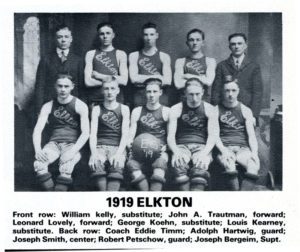
ELKTON, 1919, STATE BASKETBALL CHAMPIONS: Front row: William Kelly, John A. Trautman, Leonard Lovely, George Koehn, Louis Kearney; Back row: Coach, Eddie Timm; Adolph Hartwig, Joseph Smith, Robert Petschow; Superintendent, Joseph Bergeim.
The 1916 tournament in Huron was actually the first with a “State Association” in charge. In reality the “State Association” was learning the ropes from the Huron College crowd. Huron won the championship in 1917 and Lead in 1918. Elkton won in 1919, and again the following year. This was the last time that the state tourney was to be held in Huron for many years. The site rotated between Mitchell and Sioux Falls during the 1920s. Yankton High School won the title seven times between 1922 and 1931.
It was Yankton’s dominance, along with Madison, Mitchell, Huron, Aberdeen, and Sioux Falls winning titles, that led to a big change in 1936. In a move considered revolutionary at the time, South Dakota divided its boys basketball teams into two divisions based on enrollment. The small school tournament was classified as Class B. The large schools were in Class A. In the “B” class were some 250 schools, with enrollments less than three hundred students. In truth, an attempt at some sort of division was attempted in 1930 when eight regional winners went to one tournament, which was won by Huron, while the regional losers went to the a “B” tournament, which was won by Mitchell over Volga. There were, however, only about six hundred spectators in the Corn Palace for the “B” championship game, and he event lost more than five hundred dollars of the Association’s money.
For the state’s smallest schools, the idea of their own state boys basketball tournament was gone, but not forgotten. Six years later it was resurrected. The result caught the fancy of South Dakotans to the extent that there would be no turning back a second time. Coach Elijah Smith’s Oglala team from the Pine Ridge Indian Reservation won the 1936 “B” crown with a 24-22 win over Bridgewater, as thirteen hundred fans watched.
Teams of the Decades in Class A, Class B, and Class AA, which surfaced in 1986 when the state went from two classes to three, have been named periodically; as have All-state, All-time teams, and even All Class teams. For the purpose of this chapter, the 1930s, 1940s, 1950s, 1960s, 1970s, 1980s, 1990s and first decade of the twenty-first century will be examined through the eyes of at least one standout player from each decade.
Before we examine these performances, a look at refereeing through the years seems in order. Mentioned earlier was Harry Bahr, head referee in the 1912 inaugural boys tourney. No record is available between 1912 and 1927, when Huron beat Aberdeen in the finals. Attendance had grown to the point that the Association had sufficient resources to bring in officials from afar. The 1927 tournament was refereed by W. R. Smith and Harold Rogers, both of Minneapolis. In 1928 Smith worked the whistle with R. W. Longstreet of Chicago. The same pair officiated in 1929. In 1930 it was J. R. Nichols of Minneapolis and Fred Miller of Chicago. They came back the next year. In 1932 Miller was joined by L. M. Clarno of Chicago.
A familiar Upper Midwest name popped up as a referee in the 1933 tournament. Halsey Hall, who eventually became a very busy sports commentator and writer in Minneapolis, was paired with E. J. Dahl of Winona, Minnesota. The out of state pattern continued through the 1935 event when Ozzie Cowles of River Falls, Wisconsin, later the University of Minnesota men’s basketball coach, officiated with Fred Miller.
Referees for the inaugural Class B tourney in 1936 were Cy Holgate of Aberdeen and Leo Harmon of Mitchell. In 1937, when the rule calling for a center jump after every basket was eliminated, it was L. S. Herting of Rapid City and F. D. Whittenback of Aberdeen. Holgate was in his usual role of securing the referees. By 1938, E. L. Bergsagel and Roy Davidson, both of Aberdeen, were working the “B” tourney. Ed Livingston was at the “A” tourney. In 1939 Vince Galvin, like Livingston from Sioux Falls, joined the crew for the “A” tourney. Ken Dennis of Sioux Falls and R. E. Coffey of Brookings paired to call the “B” tourney.
Starting with the advent of World War II and thereafter, South Dakotans have carried the responsibility of officiating state boys basketball tournaments.
In addition to officiating, another continuing development in basketball in South Dakota should be noted. This development was a switch in emphasis from girth to height in the physical attributes of the players. In the former regard, this is what the Aberdeen News reported after its Eagles had fallen to Salem, 32-21 in the 1914 finals. “The Salem team, which is only slightly heavier than Aberdeen, played a good, clean game.” The article continued, demonstrating that nothing is new in journalism: “Luck was with Salem all the way through — although Aberdeen does not attribute Salem’s victory to luck.”
In a report of the same game in the Pioneer Register of Salem it was stated: “The losers were entirely outclassed in all departments. The teamwork of Salem was nearly perfect.” The Sioux Falls Argus-Leader reported: “ Salem’s fast basketball quintet proved too much for Aberdeen.”
In 1926 the Salem Pioneer Register, following the school’s second state title stated: “Before an overflowing crowd at the Sioux Falls Coliseum, Salem proved to be the greatest basket ball team that South Dakota had ever produced. George Edmonds is peer of South Dakota high school basketball coaches.” Sioux Falls was beaten by Salem in the first round of the state tournament. Sioux Falls coach, Joe Hutton observed: “Salem has a better team than many large colleges. The best team by far won.” Hutton would later coach at Hamline University. Strength was still the top physical gift a player could have. Height and finesse were shouldering their way in along side muscle, tenacity on defense, and foot speed. Much was made of Don Timmerman, a six foot eleven center of Sioux Falls Washington. Timmerman led Washington to the state tourney in 1936. He would later play at the University of Wisconsin. The tall guy of the 1942 Class A tournament was six foot six, Gene “Hap” Sagen. His Rapid City teams appeared in four straight tournaments, culminating with the 1942 Class A championship. Six foot six Bob Marske of Class B Andover attracted national attention during the 1944 season. Adolph Rupp of Kentucky expressed interest in Marske attending his university. Marske chose not to attend college, but was a standout in South Dakota independent basketball for many years.
As late as 1938 attention was given to the fact that B tourney entrant, Gregory averaged one hundred and eight-four pounds per player. After this time the study of physical extremes would focus more and more on height. In John Papendick’s exhaustive compilation of South Dakota high school championships (Aberdeen American News, July 24, 2002) he notes that the State A tournament of 1973 featured seven players, six foot seven or taller.
By 1953 the Class B tournament had exceeded the A in attendance and gate receipts. Thus becoming this South Dakota Athletic Association’s biggest money maker. By 1979 the “B” tourney gross income had topped the $100,000 mark, as “sold out” signs dotted the tourney sites. Small school basketball had become the “uncrowned” king of South Dakota athletics.
A move to three classes was made in 1986. Dakota Christian near New Holland won the B event. While Hanson won in the “new” Class A, and Mitchell in the “new” Class AA.
Now the decades, starting in the 1930s, with emphasis on the accomplishments of a favored few among the many.
THE THIRTIES
The first two decades of boys state basketball tournaments in South Dakota were characterized by small town schools holding their own against the bigger schools. Titles were won by Redfield, Salem (twice), and Elkton (three times). Lead, 1918 titlist and Madison, the 1921 champion, were considered small schools at this time. In addition, schools which eventually wound up in the Class B ranks took home thirteen second place trophies. The last two small school runners-up were Marion in 1933, losing to Aberdeen; and Miller in 1935, losing to Mitchell.

ARLINGTON, 1938 CLASS “B’ CHAMPIONS: Front row: Dean Ecklien, Wes Johnson, Dave Johnson, Wayne Holcomb, Keith Miller; Back row: mgr., Howard Brown, Howard Johnson, Dick Clausen, Ervin Manley; Coach, Dale Erret.
Arlington made the Class B tourney three of the first four years it was held, and they won it all in 1938, which made folks start looking up the word dynasty in the dictionary. Dave Johnson recalled those days with obvious animation. He stated: “ I had been a sophomore when we finished fifth in the first B tournament, 1936. We were led by John Billington and Oliver Johnson. We lost in the first round to Oglala, the eventual champion. In 1937 we couldn’t wait to get back there and try again. We were really crushed when we lost to White in the first round of the region in Brookings. The loss was one of only three games we lost in three years. Coach, Dale Errett guided us through a perfect 30-0 season in 1938. Defense was the key to our success. In the state finals we beat Doland, 32-17. They had given us our only close call during the regular season. My brother, Wesley Johnson and I were All Tournament, as well as teammate Dean Ecklein.” Johnson, who played collegiately at Dakota Wesleyan, would later officiate in the State “B” event. Dave died in 2004.
In 1939, Arlington lost to eventual champion, Deadwood, in the semi-finals. Teams did not play for third and seventh place in those days.
THE FORTIES

WEBSTER, 1947 CLASS “B” CHAMPIONS: L to R: Coach, George Hauk; Pirmin Trautner, Jack Bedessem, Allen Paulson, Ed Majeske, Harvey Hanson, Rodney Soyland, Gene Alwin, Hartney Farmen, Leonard Naessig, Ed Peters; Assistant coach, L. Adell. Webster won consecutive Class “B” State Championships in 1946, 1947, 1948.
Team talk was dominated by Mobridge in the first half of the decade. Mobridge won two Class B championships and lost another time in the semi-finals. Webster was the dominant team of the forties’ later years. Runner-up in 1945, they followed with three state championships from 1946 through 1948. One individual player, Jim Iverson of Platte, proved to be equally noteworthy. Iverson played in four straight state tournaments. He was all tournament each year, setting an all time scoring record of 253 points in eleven games. No third place game was played in 1945. Iverson’s record lasted forty-five years. Chuck Welke of Warner broke the record in four tourney appearances. Warner was a runner-up in 1992 and followed with State B championships the following two years.

JIM IVERSON, PLATTE
Iverson would play collegiately at Kansas State, and later coach North Central Conference championship teams at South Dakota State University. What kind of courage must have it taken for a small town boy to head off to Division I basketball in the late 1940s? Kansas State was ranked as high as third nationally his junior and senior years. The Wildcats were runner-up to Kentucky in the 1951 tournament. Jim would later state that: “ I guess that I was apprehensive. But it was nothing compared to the time when we went in to “big” Sioux Falls for the Tri-State Tournament when I was a twelve year old kid. I stared around for two days. I thought: ‘Wow, this is huge’.” Iverson was drafted and signed by the Boston Celtics after his senior year of 1952. He played and toured with the College All-Stars against the Harlem Globetrotters.
THE FIFTIES

HAYTI, 1954 CLASS “B” STATE CHAMPIONS: Front row, L to R: Harvey Schaefer, Garney Henley, Harold Henley, Gordon Roe, Jery Sour; Back row, L to R: mgr. Bill Brown; Harley Peterson, Donald Walder, Lewis Shelsta, David Paulson, Ronald Pronty; Coach, Jim Marking.
The first half of the decade belonged to Jim Sutton and Kent Hyde of Onida. Onida was the “B” champion in 1953, and both of its stars went on to South Dakota State University. Coach Jim Marking’s Hayti Redbirds made four straight trips to the State B tourney. Hayti had two runner-up finishes, a sixth place in 1953, and a championship in 1954. Hayti’s Garney Henley, like Jim Iverson, was a standout and leader in four straight tournaments. Marking referred to the “B” tourney as the “Mardi Gras of South Dakota.” It certainly was, gaining fan support and momentum with every passing season. Bob Swanhorst of Cresbard and Freddy Knife of Cheyenne Agency created many late decade memorable moments. Each enjoyed a B title.
The most dynamic moment of the decade centered upon the 1958 champions of Canistota, under coach Doug Cowman. There could be no more dramatic finish to a basketball game than the one that propelled the Hawks to their crown. Down three points with four seconds remaining, Roger Faber went up for a shot. It went in. He was bumped while shooting. He made the free throw which sent the game into overtime. Canistota had trailed by as many as eight points with two minutes remaining in regulation time. Canistota’s Gary Snow’s late basket was the game winner, as he rebounded his own missed shot. Reflecting on the championship, forty six years later, Faber stated: “You know, because of that moment, I think; whenever anyone asks me where I am from, I tell them, South Dakota. That despite the fact that I have lived and worked in Minneapolis considerably longer than my growing up years at Canistota and the University of South Dakota.” Roger was a standout NCC player.

CANISTOTA, 1958 CLASS “B” CHAMPIONS: Standing, L to R: mgr. Gene Barmann; Steve Clark, Gilbert Stickfort, Wayne Ortman, Allen Schlueter, Gayle Dawson, Ron Ondrozeck; Kneeling: Bob McKay, Les Parry, Rog Faber, Gary Snow, Ron Wendland.

SIOUX FALLS WASHINGTON, 1956 CLASS “A” CHAMPIONS: Back row, L to R: mgr. Bob Bottge; Chuck Anderson, Mike Gibson, Bob Admunson, John Armstrong, Jim Luce; mgr. Thane Johnson; Front row, L to R: John Simko, Wayne Bose, Bruce Qualset, Ken Barstow, Fred Hecker, Howard Leapley, Rick Devereaux. The 1955-56 Sioux Falls Washington boys athletes are the only high school athletes to win five high school sports championships in the same school year. (football, golf, basketball, tennis, and track).
The Class A side of the decade is highlighted by the Sioux Falls Washington Warriors who won back to back titles in 1955 and 1956. Jim Marking moved to Watertown from Hayti. Marking coached the 1959 Watertown Class A championship team.
THE SIXTIES
The most piercing occasion in Class A during the decade of the sixties was in 1966 and 1967. Webster, coached by Bob Swanhorst, and Milbank, coached by Dave Wolsky, stole titles from the larger schools. Both coaches were Augustana College graduates.

ALEXANDRIA, 1965 CLASS “B” STATE CHAMPIONS: Back row, L to R: Coach, Gerald Sayler; Roger Thomas, Bruce Sacton, Al Blackenship, John Thomas, Mel Thomas, Gus Krueger, Greg Heineman; Assistant coach, Gary Brost; Front row: Ronald Schulz, Leon Michael, John Wenande, Randell Pitts, Kevin Arend.
John Thomas of Alexandria in Class B had the distinction of playing on two state champions in 1963 and 1965. The year off between championships was not by design. Thomas recalled: “ I had never been to Sioux Falls until we went there to watch the 1962 tournament. I was a freshman then and we had lost out early. We knew lots about Bridgewater, which is near us. It lost to Pine Ridge, the eventual champion in the semis, 36-34. The next year, myself and brothers, Mel and Kent were all on the Alex varsity. Another brother, Dave was the student manager, or maybe he was in 1965. Anyway it was a family thing. We beat Pine Ridge, 82-65 in the 1963 finals, the highest scoring championship game in B history to that night.”
Alex did not make it back to the “B” in 1964, although John Thomas did make the All-State team as a junior. Thomas continued: “ The next year (1965) Alex, including brothers, Roger and Mel Thomas, got back to the state. It was unbelievably tough. We beat Agar by a bucket, and Brandon Valley by a point.” In those two games, Thomas had twenty-seven points and nineteen rebounds against Agar, and thirty-one points and twenty-two rebounds against Brandon Valley. In the State B finals against Tripp, a 59-54 triumph, Thomas had twenty-five points and eleven rebounds.
The 1965 tourney was held at the Sioux Falls Arena. Thomas recalled that “Having been there in huge crowd surrounding for March of Dimes events during the regular season helped. Like all South Dakota would be, I was in agony the next year when I was a freshman at South Dakota State. I came down to the district tournament. Brother Mel fouled out after they had Parkston down by eight or ten points in the fourth quarter. Parkston went on to defeat Alexandria and eventually won the 1966 B championship.
The Thomas kids viewed the “B” championships from various geographical locations. Their father, Reverend Roger Thomas, served Methodist congregations in nine South Dakota communities. John Thomas was an all NCC performer at South Dakota State and later had a tryout with the Boston Celtics.
THE SEVENTIES
This decade is secure in history because of an uncanny link between Class A and Class B basketball. In 1974 Yankton won the “A” and Hamlin won the “B”. Yankton, which had finished second the previous two years, won with almost unmatched ease. The Bucks rolled through their three state tourney games under coach Bob Winter by a combined forty-four points. Yankton’s star was six foot ten inch center, Chad Nelson. Nelson scored 1,668 points during his four year prep career. Chad would later play briefly with the University of Minnesota and then at Drake University. He was drafted by the New Orleans Jazz in 1978. He later played professionally in Israel.

HAMLIN COUNTY, 1974 CLASS “B” STATE CHAMPIONS: L to R: Doug Riter, Steve Brown, Roger Brown, Jan Buri, Doug Strande, Wally Gustafson, Harley Tetzlaff, Dana Trumm, Brad Zimprick, Harvey Aho, Bruce Wadsworth, Mike Stevenson; Kneeling: Coach, Dick Baysinger; mgr. Bryan Person; Assistant coach, Bryon Paulson.
Hamlin had to work tirelessly in its 1974 “B” championship game before turning back Parker, 36-33. Hamlin led 34-33 before Steve Brown made the final field goal. Brown scored fifty points in an 80-68 win over Salem in the semi-final game. He scored thirty-three points in Hamlin’s’ 68-63 victory over Sully Buttes in the first round. Brown averaged thirty-three points a game his senior year at Hamlin. He was later an all NCC player at South Dakota State.
Brown recalls that: “ My scoring at Hamlin, 2,212 career points, is misleading, because I had great teammates. But I always will have among my high school memories what might have been.” Brown was referring to the fact that as kids both he and Chad Nelson lived in Bryant. “We were always going one on one against each other, which helped me learn to get shots up against much taller players.” Brown played his prep and collegiate basketball at five foot eleven. Nelson was already six seven when he entered his teenage years.
The later portion of the decade featured the dominance of Armour in the Class B ranks. Yankton won another Class A title in 1978 after finishing second in 1976.
THE EIGHTIES
The significance of boys basketball was off the court during the decade of the eighties. In 1986 the tournament structure went to three classes. The following year, 1987 basketball tourney income for all classes, including boys and girls, exceeded $ 500,000 for the first time. In the AA, large school division, Mitchell under coach Gary Munsen, won the championship three straight years. The Kernels had a runner-up finish in 1988.
Among the smallest schools in the “B” ranks, Lyman had championship type power throughout the decade. Vermillion won state championships in 1988 and 1989, as the mid-sized schools, now called Class A, had their own tourney.
Individually, Alan Miller was to achieve the most notoriety after leading Stickney to the 1981 Class B championship. He became the all time leading collegiate scorer at Dakota Wesleyan. He later had a hand in the development of his nephew, Mike Miller.

PINE RIDGE 1987 STATE “A” CHAMPIONS: Top row, L to R: Jim Colhoff, Paul Cedarface, Bryan Brewer, Willie White, Brent Brewer, George Bettelyoun, Tony Brewer; Second row from the top, L to R: Jon Garnier, Jeff Big Crow, Joe Esteth; Third row from the top: Ron Martin, Don Garnier; Bottom row, L to R: Assistant coach, Charles Zimiga; Coach, Jess Mendoza.
In 1987 Willie White paced Pine Ridge over Lennox to the Class A crown by scoring thirty-four points in a 60-53 win in the championship game. White scored seventy-five points in Pine Ridge’s three games of the 1987 tourney.
THE NINETIES
MITCHELL, 1996 STATE “AA” CHAMPIONS
The beat went on for the Mitchell Kernels in the final decade of the twentieth century. Mitchell won five titles in the nineties, the last in 1997. The spark for the 1996 and 1997 championship teams was provided by Mike Miller. Miller first began to attract attention as a rapidly improving fourth grader. He would add inches, and shooting skills from long range. He honed his basketball savvy as he proceeded through Mitchell High, the University of Florida, and a National Basketball Association career which began with Rookie of the Year honors. Miller led the University of Florida to the NCCA finals, and went on to join Rapid City Stevens graduate Eric Piatkowski in the NBA.
In the Class A ranks, Red Cloud won the 1995 title. The Crusaders were coached by Dusty LeBeau who had made earlier trips to the state tourneys with Pine Ridge and Little Wound.
In Class B, twins and ranch sons, Scott and Chad Boekelheide led Northwestern to three state title games. Northwestern won in 1989, finished second in 1990; and won another B title in 1991. The Boekelheide twins combined for one hundred and fourteen points in the three title games.
2000-
Josh Mueller of West Central led his team to three straight Class A championship games. The Trojans were runners-up in 1999, and won “A” titles in 2000 and 2001. Josh’s performance in the 2001 State A tournament is one of the outstanding tournament performances in South Dakota High School basketball history. Josh set four, all time records during the 2001 State Tournament:
Most points, three games, championship play, 147
Most points, semifinal game: 60
Most points, championship game: 55
Most points in tournament, including consolation play: 147
His sixty and fifty-five points are the two highest individual points scored by a Class A player in a game in South Dakota basketball history.
As South Dakota boys basketball swings into the twenty-first century, a return to historical events has already been seen. In 2005 Elkton won the Class B title, their first basketball championship since 1919. Custer claimed five Class A titles from 1990 on. That is Custer High School, not the battlefield general.